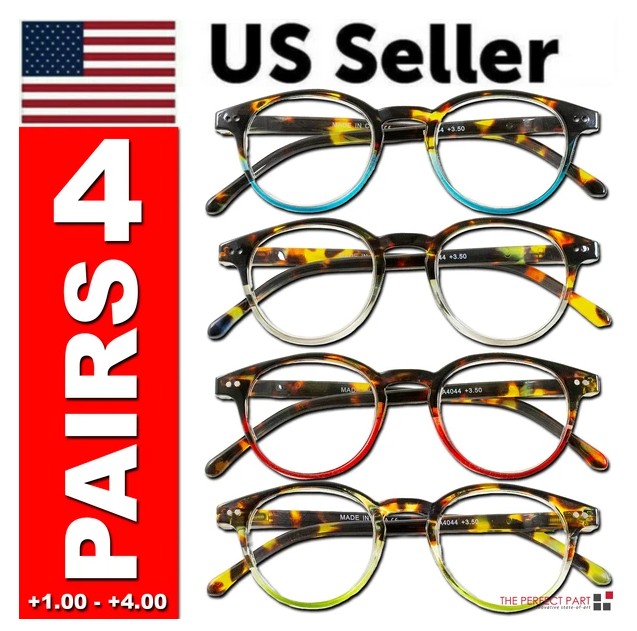

Photos from current listings. Actual item, color, and included accessories may vary.
Reading Glasses Buying Guide
Reading glasses are magnification eyewear that correct presbyopia, and the primary trade-off is optical clarity and hinge durability versus multipack convenience. Buyers choose between precision-ground lenses with spring hinges and plastic molded lenses with friction hinges. The decision rule is simple: pick a single pair with spring hinges and accurate diopter over bulk packs, because mislabeled power and hinge fatigue are the two failure modes in cheap readers.
At a glance
- Category
- Sunglasses & Eyewear
- Last updated
- Nov 27, 2026
Current offers
Highlights
- Lens power ranges from +1.00 to +4.00 diopters in 0.25 steps; +1.00 to +2.50 covers most first-time presbyopes, +3.00 and above suits advanced presbyopia or post-surgical needs.
- Spring hinges flex past 90 degrees and resist breakage; friction or barrel hinges on bulk packs crack at the temple joint within months of daily use.
- Anti-blue-light coating blocks 380-450 nm light but degrades contrast and color accuracy; it is not a substitute for accurate magnification or UV400 sun protection.
- Photochromic lenses darken in UV light but do not darken behind car windshields or most office windows, so they are indoor-outdoor readers rather than driving glasses.
Best use cases
- Pick a single +1.25 to +2.00 pair with spring hinges and a hard case for daily screen and book reading; skip 4-6 pack bundles where per-pair hinge quality is lowest.
- Pick photochromic anti-blue-light readers for commuting or outdoor reading in changing light; skip them for night driving or extended color-critical work.
- Pick a 4-pack of low-power readers (+1.00 to +1.50) as scattered spares for desk, car, and bedside if you accept plastic hinges; skip multipacks when you need one reliable all-day pair.
- Pick full-rim square or oval frames with adjustable spring temples for wide faces or high cheekbones; skip thin metal half-rim readers if you need impact resistance or a secure fit.
Buying tips
- Match diopter to your add power from an eye exam: +0.75 to +1.25 for early presbyopia in the 40s, +1.50 to +2.25 for the 50s, +2.50 to +3.50 for the 60s and beyond.
- Choose spring hinges over friction hinges for any pair worn more than an hour daily; spring-loaded temples distribute stress and survive pocket and purse abuse.
- Look for lenses labeled optical-grade or CR-39-equivalent resin; molded acrylic lenses scratch faster and distort at the edges.
- Prefer frames with adjustable silicone nose pads or molded acetate bridges; bulk-pack readers with fixed plastic bridges slide and create pressure points.
Specs
| Lens Power | +0.75 to +4.00 diopters, 0.25 steps |
|---|---|
| Hinge Type | Spring-loaded vs friction barrel |
| Lens Material | Optical resin vs molded acrylic |
| Lens Coating | Anti-reflective / UV400 / blue-light |
Related searches
What to check before buying
- Measure your pupillary distance (typically 58-70 mm) and choose frames whose lens centers align with your eyes; mismatched PD causes eye strain.
- Confirm frame width matches your face: temple-to-temple width should equal your face width plus 2-4 mm for comfort.
- Check that lenses are UV400 or offer anti-reflective coating if used outdoors; uncoated readers glare under sun and office lighting.
- Verify diopter is printed on the temple arm and matches the labeled power; bulk packs often mix powers or mislabel by 0.25 diopters.
FAQ
Data sources: eBay / Amazon listings and product attribute feeds. Updated Nov 27, 2026.
Some links on this page are affiliate links. If you buy after clicking one, we may earn a commission at no extra cost to you. This does not change which products appear here or their order. Affiliate disclosure.